Orchard Tutor ex-RJC grad/ACJC grad full time tutor for IGCSE IB Diploma IP GCE O level PSLE Primary, Secondary and International Schools Tuition Home Based Premium Education by eduKate Tuition Centre
This month, we are teaching eduKate students Critical Thinking Skills. Students will be receiving their notes and shall cover the below modules:
What is critical thinking?
What are the components of learning?
What are the procedures to achieve critical thinking?
How to interpret and analyse data?
What do we need to avoid doing to achieve a balanced result?
Importance of critical thinking in our education.
Aims of this module: To create awareness in students attempting questions in their exams. Relevance of critical thinking skills to English shall be applied to composition writing and answering comprehension questions during the first two lessons.
Composition
Students are required to demonstrate reasoning in their compositions and develop a realistic approach to story telling. During the process of creating a story, students shall use the 3 pictures composition approach introduced in the new syllabus PSLE format. The students are required to gather and include effective implementation of tools from their creative writing classes. They also need to draw from their past experiences when fabricating their plot.
Comprehension
Students are required to demonstrate critical thinking skills of the following basic 6 questions: who, why, where, when, what and how when attempting to resolve questions in the new syllabus format PSLE questions. They are also required to critique and infer from the passage using the said skill.
Please be informed of the new format change in Primary School English, Singapore for 2015. This applies to PSLE English exam format and class practices, most noticeable in the Composition and Comprehension section. This change shall affect and include the PSLE syllabus for English, 2015 by Ministry of Education, MOE Singapore.
So parents buying the new assessment books or textbooks, kindly purchase only the latest revision or wait till the new books are out before purchasing. Currently, I still see the 2014 Assessment books being sold in the stores and it will be a waste buying that version to replace with the new ones later on.
Here is a summary of the changes, as informed by the MOE. A copy of the syllabus is included at the bottom of this page. (downloaded from SEAB website)
The Same:
English skill levels are the same as PSLE 2014. The syllabus remains as the STELLAR programme introduced by MOE in 2013 for Primary 4 students. This is the chronological order of revisions to MOE’s EL Syllabus.
2001-New EL Syllabus introduced.
2006-EL Syllabus review by EL Curriculum and Pedagogy Review Committee
2010-incorporation of changes recommended by 2006 Review Committee to previous 2001 EL Syllabus
2013-STELLAR Programme starts for Primary 4
2015-revision of STELLAR programme only to format of PSLE English Language (EL) and Foundation English Language (FEL)
The Changes:
New Assessment books for PSLE ENGLISH SEAB Syllabus 2015
2015 changes to PSLE EL and FEL Papers are as follows:
Continuous Writing: Changes from optioning 2 fixed scenario question to 1 visual stimulated question. Freedom to write using narrative, exposition, descriptive or any appropriate methods taught in school. Approach to story writing from different perspectives, leading to multiple plots for different candidates. Creative writing and freedom in thought seems to be embraced in this revision.
Comprehension: New format with tables and different ways to answer questions, requiring students to be able to adapt answering skills to changing situations.
Listening Comprehension: Higher amounts of visual stimulation so that candidates will require a higher mastery of their cognitive skills to answer questions properly.
Oral Communication: Picture Discussion and Conversation will be replaced to Stimulus based Conversation. It shall be themed to the reading aloud piece and shall require students to give their own views on the topic. This is in line with the MOE to require students to be more social and interactive, improving their social skills for the 21st Century.
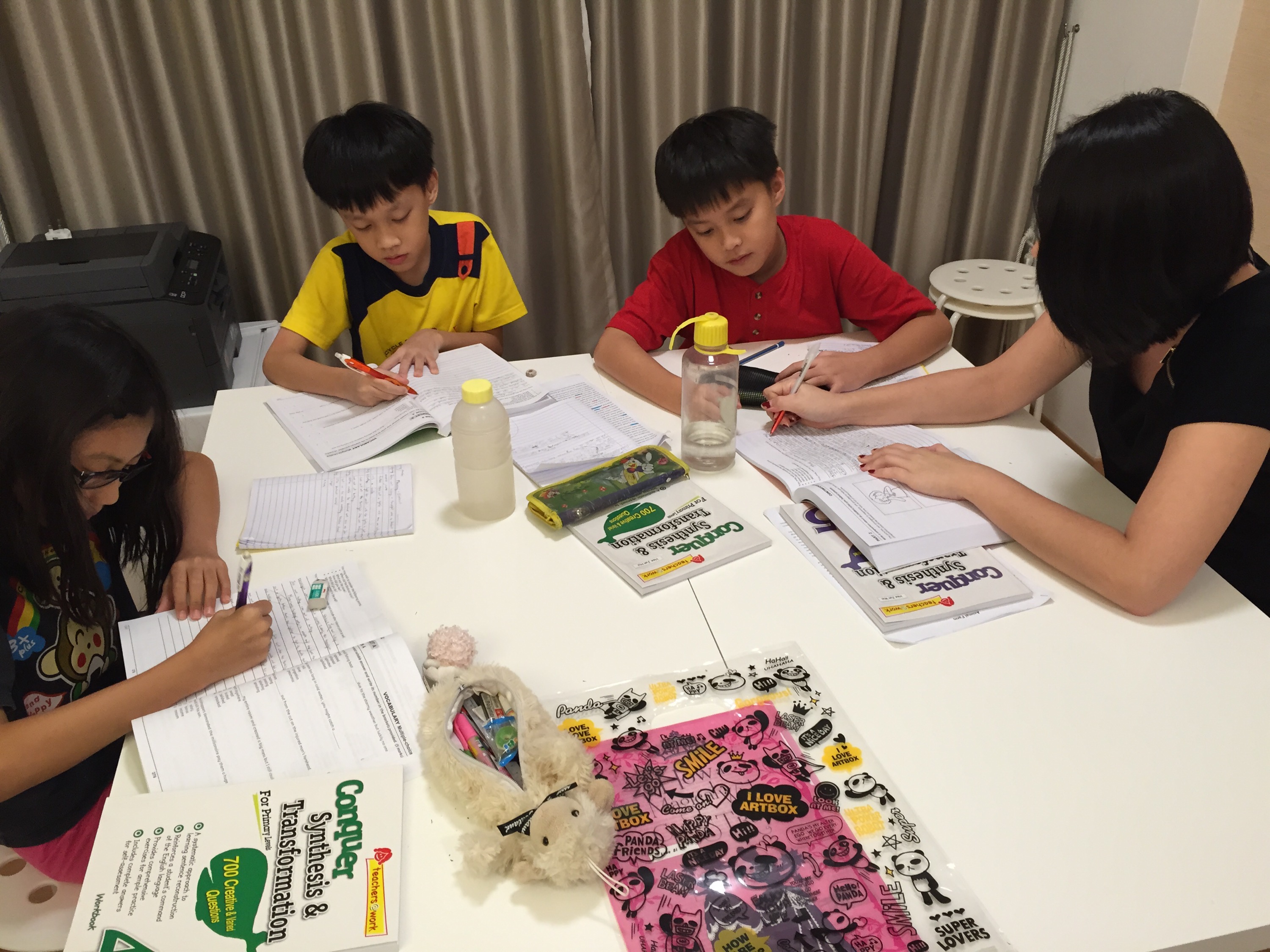
P6 eduKate Students at Tampines Tuition CentreeduKate Tuition Class SEAB PSLE Syllabus Primary 6 English Tuition at TampineseduKateSG Primary Students at Punggol Tuition Centre Prive Condominium doing PSLE SEAB Syllabus English Primary 4 and 5
Here is a copy of the PSLE English Syllabus by MOE:
PSLE ENGLISH LANGUAGE SYLLABUS 2015
Implemented from the Year of Examination 2015
PURPOSE OF EXAMINATION
The purpose of the examination is to assess the candidates’ attainment in English Language based on the Learning Outcomes stated in the English Language Syllabus 2010: Primary & Secondary (Express / Normal [Academic]). The Learning Outcomes form the basis for the assessment objectives listed on page 3.
ASSESSMENT OBJECTIVES In this English Language examination, candidates will be assessed on their ability to:
In Paper 1 (Writing)
AO1 write to suit purpose, audience and context in a way that is clear and effective
AO2 use appropriate register and tone in a variety of texts
AO3 generate and select relevant ideas, organising and expressing them in a coherentand cohesive manner
AO4 use correct grammar, spelling and punctuation
AO5 use a variety of vocabulary appropriately, with clarity and precision
In Paper 2 (Language Use and Comprehension)
AO1 demonstrate comprehension of a range of texts at the literal and inferential levels
AO2 show understanding of implied meaning, and make judgement and evaluation, byreading and/or viewing closely and critically
AO3 show understanding of how contextual use of lexical and grammatical itemsshapes meaning
AO4 demonstrate the correct use of grammar, spelling and punctuation, and theappropriate use of vocabulary in given contexts
In Paper 3 (Listening Comprehension)
AO1 demonstrate understanding of the content of a variety of spoken texts at the literal and inferential levels
AO2 identify key messages, main ideas and details in a variety of spoken texts
AO3 infer and draw conclusions by listening critically
In Paper 4 (Oral Communication)
AO1 read with good pronunciation, clear articulation and appropriate intonation in order to convey the information, ideas and feelings in a passage
AO2 produce a well-paced, fluent reading of a passage
AO3 express their personal opinions, ideas and experiences clearly and effectively inconversing with the examiner
AO4 speak fluently and with grammatical accuracy, using a range of appropriatevocabulary and structures
EXAMINATION FORMAT Candidates will be assessed in the following areas:
PAPER
COMPONENT
ITEM TYPE
NO. OF ITEMS
MARKS
WEIGHTING
DURATION
1 (Writing)
Situational Writing Continuous Writing
OE OE
1 1
15 40
27.5%
1 h 10 min
2 (Language Use and Comprehension)
Booklet A: Grammar Vocabulary Vocabulary Cloze Visual Text Comprehension Booklet B: Grammar Cloze Editing for Spelling and Grammar Comprehension Cloze Synthesis / Transformation Comprehension OE
MCQ MCQ MCQ MCQ OE OE OE OE OE
10 5 5 8 10 12 15 5 10
10 5 5 8 10 12 15 10 20
47.5%
1 h 50 min
3 (Listening Comprehension)
Listening Comprehension
MCQ
20
20
10%
About 35 min
4 (Oral Communication)
Reading Aloud Stimulus-based Conversation
OE OE
1 passage 1 visual stimulus
10 20
15%
About 10 min (5 min preparation time; about 5 min examination time)
Part 1 (Situational Writing): Candidates will be required to write a short functional piece (e.g. letter, email, report) to suit the purpose, audience and context of a given situation.
Part 2 (Continuous Writing): Candidates will be required to write a composition of at least 150 words in continuous prose on a given topic. Three pictures will be provided on the topic offering different angles of interpretation. Candidates may also come up with their own interpretation of the topic.
Paper 2 (Language Use and Comprehension)
Candidates will be assessed on their ability to use language correctly and to comprehend visual and textual information.
Paper 3 (Listening Comprehension)
This paper comprises 20 multiple-choice questions which test candidates’ ability to understand spoken English. The texts may be in the form of news items, announcements, advertisements, instructions, explanations, conversations, speeches and stories. Graphic representations will be used for the first seven items. Each text will be read twice. Time will be given for candidates to read the questions before the first reading of each text.
Paper 4 (Oral Communication)
For Reading Aloud, candidates are assessed on their ability to pronounce and articulate words clearly, as well as their ability to read fluently with appropriate expression and rhythm.
For Stimulus-based Conversation, candidates are assessed on their ability to give a personal response to a visual stimulus and engage in a conversation on a relevant topic.
Press Releases (from moe.gov.sg)
September 3, 2012
Learning of English to Develop 21st Century Competencies
STELLAR English for Upper Primary to Start from Primary 4 Next Year
1) Upper primary students can look forward to more interactive English lessons with the implementation of the revised 2010 English Language (EL) Syllabus at Primary Four from 2013. The new syllabus incorporates a sharper focus on 21st century competencies to enable our students to communicate effectively and confidently in the globalised world. Students who are taught the new syllabus will sit for the revised Primary School Leaving Examination (PSLE) EL papers in 2015.
2) The Ministry of Education (MOE) reviews the EL Syllabus regularly to ensure that it is relevant to the changing environment and profile of our learners. The 2010 EL Syllabus builds on the strengths of the 2001 syllabus, and aims to equip our students with the language skills they need for day-to-day communication and for the next stage of learning. It emphasises building a strong foundation in the language and enriching language learning for all as recommended by the EL Curriculum and Pedagogy Review Committee in 2006.
3) The key feature of the new EL Syllabus is a systematic approach to teaching language skills, using rich texts and a variety of language resources to enable students to appreciate the language beyond the classroom. This approach is delivered through the Strategies for English Language Learning and Reading (STELLAR) programme in primary schools.
4) The STELLAR programme, developed by MOE, provides the instructional materials, teaching strategies and training to enable teachers to implement the EL syllabus effectively. The STELLAR programme is designed to cater to a diverse range of EL learners in our school system and was developed based on research carried out in Singapore schools. As part of the programme, EL is taught through stories and texts that appeal to children, with explicit grammar instruction. Students are provided with opportunities to express themselves in an environment where language learning can be enjoyable yet purposeful. Through the reading of engaging stories in class, students get to speak extensively, discussing and sharing their views with the teacher and their peers. The main purpose is to build students’ confidence in speech and writing, and enhance their learning of the language. Please refer to Annex A for an overview of the 2010 EL Syllabus. More information on the STELLAR programme can be found at the STELLAR website.
Assessment
5) The revised PSLE English Language (EL) and Foundation English Language (FEL) examination papers will be introduced from 2015, in line with the changes to the teaching syllabus. The language skills tested in the revised PSLE are the same as those tested in the current PSLE. However, the revised examination papers give greater emphasis to the 21st century competencies in the teaching syllabus by:
Giving students greater scope for providing personal response in speaking and writing
Greater emphasis on viewing skills integrated with listening and reading
6) The changes to the examination papers are outlined in Annex B.
Annex B
Revised PSLE English Language (EL) and Foundation English (FEL) Examinations
The revised English Language (EL) examination comprises four papers. The main revisions are as follows:
For the Continuous Writing component of Paper 1, instead of two questions with fixed scenarios for candidates to choose from to write a narrative, one topic is offered which can be approached from any one of several perspectives. To help candidates think about the different perspectives of the topic, visuals will be provided. In addition, candidates will be free to write a narrative or exposition or any appropriate text type learned in schools.
There will be a new Visual Text Comprehension section in Paper2 in the form of multiple choice questions (MCQs). One such example would be questions based on a poster.
For the Comprehension Open-ended section in Paper 2, the types of questions will now be varied and could include, for example, tables which candidates will fill in using information from the passage.
The Listening Comprehension paper will have more items with graphic representation compared to the existing paper.
For the Oral Communication paper, the existing Picture Discussion and Conversation components will be replaced by the Stimulus-based Conversation component. Candidates will give their personal response to a visual stimulus that is thematically linked to the Reading Aloud passage. Candidates will then move on seamlessly to a discussion on a relevant topic.
The revised Foundation English Language (FEL) examination comprises four papers. The main revisions are as follows:
For the Continuous Writing component in Paper 1, the visual stimulus, which is a series of three framed pictures in the current paper, will include an additional fourth frame featuring a question mark in the revised paper with the provision of helping words for each of the first three pictures. The picture-in- series format is to help candidates sequence their story while the question mark in the last frame is to give students the opportunity and flexibility to give their own endings to their stories.
For the Comprehension Open-ended section in Paper 2, the types of questions will be varied (e.g., graphic organisers, multiple-choice questions and sequencing-type questions might be used). Pictures may be featured together with the comprehension passages.
The FEL Listening Comprehension paper will also feature more items with graphic representation compared to the existing paper. There will be a new listening task in which candidates listen for main ideas and select the appropriate response from the three options for each MCQ.
For the Oral Communication paper, the FEL paper will also feature a Stimulus-based Conversation component in place of the existing Picture Discussion and Conversation components.
The revisions are summarized below:
English Language
Foundation English Language
Giving students greater scope for providing personal response in speaking and writing
Paper 1(Continuous Writing): Greater scope for writing from different perspectives, and flexibility for candidates to choose any text type such as narrative or exposition.
Paper 4 (Oral Communication): New Stimulus-based Conversation component will feature a context familiar to students that will provide a springboard for conversation.
Paper 1(Continuous Writing): The picture series ends with a frame with a question mark to allow candidates the flexibility to give their own endings to their compositions.
Paper 4 (Oral Communication): New Stimulus-based Conversation component will feature a context familiar to students that will provide a springboard for conversation.
Greater emphasis on viewing skills integrated with listening and reading
Paper 2 (Language Use and Comprehension): New Visual Text Comprehension section that features a multi-modal print text which will include visuals such as pictures, diagrams, charts, graphs and tables together with the written texts.
Paper 3 (Listening Comprehension): Increase in the number of questions with graphic representation.
Paper 2 (Language Use and Comprehension): Pictures may be featured together with the Comprehension passages, where appropriate, to help students comprehend the texts.
Paper 3 (Listening Comprehension): Increase in the number of questions with graphic representation.
Disclaimer: the above is downloaded from seab.gov.sg moe.gov.sg and is correct as of 15th April 2015. (last update from edukatesg.com) Any revisions from this date on shall be updated by edukatesg.com and updated with notes. This page is intended for use by edukate Singapore Tuition Centre students and parents for their reference and examination planning schedule. Kindly disregard if otherwise.
Thank you.
For an experience of our dynamic classes and how we can empower your child,
Ms Teo Yuet Ling +65 8222 6327
admin@edukatesg.com
Punggol Tuition Centre for English Math and ScienceFemale Punggol tutor Yuet Ling preparing materials for English, Maths and Science tuition. We provide up-to-date, innovative and fun materials that challenge our students intellectually.PSLE English Singapore Tuition. MOE Syllabus. Female TutorTutor Yuet Ling in Melbourne, Australia. Primary English PSLE Tuition Programme.
Herein lies the class contents and SEAB MOE Syllabus of our 2015 tutorial classes for English, Maths and Science tuition at both eduKate Tampines and Punggol Branch. MOE PSLE syllabus will be adhered to strictly with additions as listed below applied for your child’s character development and skill improvements. PSLE Syllabus by SEAB MOE can be found at bottom of this page.
Primary English
eduKate’s syllabus covers MOE guideline PSLE Syllabus English 2015 as our core lesson content.
Vocabulary
Grammar
Synthesis
Composition (Situational and Continuous)
Comprehension
Cloze Passage
Listening Comprehension
Oral and speech
In addition, we incorporate the following into our English programme:
Creative writing
Historical Knowledge
General Knowledge
Moral Ethics and Good Manners
Introduction to Newspapers and Current Affairs
Reading & Appreciation of Classical Children Story Books
English and its use in Technology and Social Media
Primary Mathematics
eduKate’s syllabus for Mathematics follows MOE guideline in accordance to cohort requirements from Primary 1-6.
In addition, we shall incorporate the following into our Mathematics programme:
Conceptual Understanding and Skill Proficiency
Heuristics and application to Problem Sums
Every day use of Mathematics
PSLE Preparatory Mathematics Classes in October 2014
PSLE Intensive Mathematics Classes in June-October 2015
eduKate Singapore Tampines Tuition Centre Student doing Secondary Math
Below are a list of schools that we currently cater to in accordance to our current location
Tampines Tuition Branch:
Angsana Primary School
Chongzheng Primary School
East Spring Primary School
East View Primary School
Gongshang Primary School
Junyuan Primary School
Poi Ching School
St. Hilda’s Primary School
Tampines North Primary School
Tampines Primary School
Yumin Primary School
Dunman Secondary School
East Spring Secondary School
East View Secondary School
Junyuan Secondary School
Ngee Ann Secondary School
Pasir Ris Secondary School
Springfield Secondary School
St. Hilda’s Secondary School
Tampines Secondary School
Tampines Junior College
United World College of South East Asia (Tampines Campus)
Canossa Convent Primary School
East Coast Primary School
Eunos Primary School
Geylang Methodist School (Primary)
Haig Girls’ School
Macpherson Primary School
Maha Bodhi School
Maris Stella High School
Ngee Ann Primary School
St. Gabriel’s Primary School
Tao Nan School
Yangzheng Primary School
Bartley Secondary School
CHIJ Katong Convent
Geylang Methodist School (Secondary)
MacPherson Secondary School
Manjusri Secondary School
Ping Yi Secondary School
St. Gabriel’s Secondary School
Zhonghua Secondary School
Nanyang Junior College
Punggol Tuition Branch:
Casuarina Primary School
Compassvale Primary School
Coral Primary School
Edgefield Primary School
Elias Park Primary School
Greendale Primary School
Horizon Primary School
Loyang Primary School
Mee Toh School
Meridian Primary School
North Vista Primary School
Palm View Primary School
Park View Primary School
Pasir Ris Primary School
Punggol Primary School
Punggol Green Primary School
Punggol View Primary School
Seng Kang Primary School
White Sands Primary School
Yio Chu Kang Primary School
Compassvale Secondary School
Coral Secondary School
Edgefield Secondary School
Greendale Secondary School
Greenview Secondary School
Hai Sing Catholic School
Loyang Secondary School
North Vista Secondary School
Pasir Ris Crest Secondary School
Punggol Secondary School
Seng Kang Secondary School
Siglap Secondary School
Meridian Junior College
North Spring Primary School
Rivervale Primary School
CHIJ St. Joseph’s Convent
Anchor Green Primary School
Fernvale Primary School
Nan Chiau Primary School
Sengkang Green Primary School
Springdale Primary School
Nan Chiau High School
Pei Hwa Secondary School
Secondary Mathematics GCE O levels at eduKate SG Tuition Centre
Current PSLE Syllabus outlined by SEAB MOE website Jan 2015 onwards
PSLE ENGLISH LANGUAGE
Implemented from the Year of Examination 2015
PURPOSE OF EXAMINATION
The purpose of the examination is to assess the candidates’ attainment in English Language based on the Learning Outcomes stated in the English Language Syllabus 2010: Primary & Secondary (Express / Normal [Academic]). The Learning Outcomes form the basis for the assessment objectives listed on page 3.
ASSESSMENT OBJECTIVES
In this English Language examination, candidates will be assessed on their ability to:
In Paper 1 (Writing)
AO1 write to suit purpose, audience and context in a way that is clear and effective
AO2 use appropriate register and tone in a variety of texts
AO3 generate and select relevant ideas, organising and expressing them in a coherentand cohesive manner
AO4 use correct grammar, spelling and punctuation
AO5 use a variety of vocabulary appropriately, with clarity and precision
In Paper 2 (Language Use and Comprehension)
AO1 demonstrate comprehension of a range of texts at the literal and inferential levels
AO2 show understanding of implied meaning, and make judgement and evaluation, byreading and/or viewing closely and critically
AO3 show understanding of how contextual use of lexical and grammatical itemsshapes meaning
AO4 demonstrate the correct use of grammar, spelling and punctuation, and theappropriate use of vocabulary in given contexts
In Paper 3 (Listening Comprehension)
AO1 demonstrate understanding of the content of a variety of spoken texts at the literal and inferential levels
AO2 identify key messages, main ideas and details in a variety of spoken texts
AO3 infer and draw conclusions by listening critically
In Paper 4 (Oral Communication)
AO1 read with good pronunciation, clear articulation and appropriate intonation in order to convey the information, ideas and feelings in a passage
AO2 produce a well-paced, fluent reading of a passage
AO3 express their personal opinions, ideas and experiences clearly and effectively inconversing with the examiner
AO4 speak fluently and with grammatical accuracy, using a range of appropriatevocabulary and structures
EXAMINATION FORMAT
Candidates will be assessed in the following areas:
PAPER
COMPONENT
ITEM TYPE
NO. OF ITEMS
MARKS
WEIGHTING
DURATION
1 (Writing)
Situational Writing Continuous Writing
OE OE
1 1
15 40
27.5%
1 h 10 min
2
(Language Use and Comprehension)
Booklet A:
Grammar
Vocabulary
Vocabulary Cloze
Visual Text Comprehension
Booklet B:
Grammar Cloze
Editing for Spelling and Grammar
Comprehension Cloze
Synthesis / Transformation
Comprehension OE
MCQ MCQ MCQ MCQ
OE OE
OE OE OE
10 5 5 8
10 12
15 5 10
10 5 5 8
10 12
15 10 20
47.5%
1 h 50 min
3
(Listening Comprehension)
Listening Comprehension
MCQ
20
20
10%
About 35 min
4
(Oral Communication)
Reading Aloud
Stimulus-based Conversation
OE OE
1 passage
1 visual stimulus
10 20
15%
About 10 min (5 min preparation time; about 5 min examination time)
Part 1 (Situational Writing): Candidates will be required to write a short functional piece (e.g. letter, email, report) to suit the purpose, audience and context of a given situation.
Part 2 (Continuous Writing): Candidates will be required to write a composition of at least 150 words in continuous prose on a given topic. Three pictures will be provided on the topic offering different angles of interpretation. Candidates may also come up with their own interpretation of the topic.
Paper 2 (Language Use and Comprehension)
Candidates will be assessed on their ability to use language correctly and to comprehend visual and textual information.
Paper 3 (Listening Comprehension)
This paper comprises 20 multiple-choice questions which test candidates’ ability to understand spoken English. The texts may be in the form of news items, announcements, advertisements, instructions, explanations, conversations, speeches and stories. Graphic representations will be used for the first seven items. Each text will be read twice. Time will be given for candidates to read the questions before the first reading of each text.
Paper 4 (Oral Communication)
For Reading Aloud, candidates are assessed on their ability to pronounce and articulate words clearly, as well as their ability to read fluently with appropriate expression and rhythm. For Stimulus-based Conversation, candidates are assessed on their ability to give a personal response to a visual stimulus and engage in a conversation on a relevant topic.
PSLE MATHEMATICS
For Examination from 2009
PURPOSE OF THE EXAMINATION
The purpose of the Mathematics examination is to assess pupils’ attainment in mathematics at the end of primary education with respect to the objectives of the 2007 Mathematics (Primary) syllabus. pdf file-PSLE-maths-primary-2007
ASSESSMENT OBJECTIVES
Pupils should be able to:
recall specific mathematical facts, concepts, rules and formulae, and performstraightforward computations. (Knowledge)
interpret data and use mathematical concepts, rules and formulae, and solveroutine or familiar mathematical problems. (Comprehension)
analyse data and/or apply mathematical concepts, rules and formulae in acomplex situation, and solve unfamiliar problems. (Application & Analysis)EXAMINATION FORMATThe examination consists of two written papers comprising three booklets.
Paper
Booklet
Item Type
Number of questions
Number of marks per question
Weighting
Duration
1
A
Multiple-choice
10
1
10%
50 min
5
2
10%
B
Short-answer
10
1
10%
5
2
10%
2
Short-answer
5
2
10%
1 h 40 min
Structured / Long-answer
13
3, 4, 5
50%
Total
48
–
100%
2 h 30 min
Notes
Both papers will be scheduled on the same day with a break between the two papers.
Paper 1 comprises two booklets. The use of calculators is not allowed.
Paper 2 comprises one booklet. The use of calculators is allowed.
Item Types
Multiple-choice Question
For each question, four options are provided of which only one is the correct answer. A candidate has to choose one of the options as his correct answer.
Short-answer Question
For each question, a candidate has to write his answer in the space provided. Any unit required in an answer is provided and a candidate has to give his answer in that unit.
Structured / Long-answer Question
For each question, a candidate has to show his method of solution (working steps) clearly and write his answer(s) in the space(s) provided.
PSLE SCIENCE
For examination from 2010
PURPOSE OF THE EXAMINATION
The PSLE Science Paper assesses pupils’ attainment in Science with respect to the aims of Primary Science Education as stated in the 2008 Science (Primary) syllabus pdf file- psle-science-primary-2008.
ASSESSMENT OBJECTIVES
The assessment objectives are as follows:
Knowledge with UnderstandingPupils should be able to demonstrate knowledge and understanding of scientific facts, concepts and principles.
Application of Knowledge and Process SkillsPupils should be able to:
apply scientific facts, concepts and principles to new situations.
use one or a combination of the following basic process skills:
Observing
Comparing
Classifying
Using apparatus and equipment
Communicating
Inferring
Predicting
Analysing
Generating possibilities
Evaluating
Formulating hypothesis
EXAMINATION FORMAT Format of Paper
The examination consists of one written paper comprising two booklets, Booklet A and Booklet B.
Table 1
Booklet
Item Type
Number of questions
Number of marks per question
Weighting (%)
A
Multiple-choice
30
2
60
B
Open-ended
14
2,3,4
40
I Booklet A consists of 30 multiple-choice questions. Each multiple-choice question carries 2 marks.
II Booklet B consists of 14 open-ended questions. Each open-ended question carries 2, 3 or 4 marks.
Duration of Paper
The duration of the paper is 1 hour 45 minutes.
the above is downloaded from seab.com.sg and is correct as of 3rd April 2015. Any revisions from this date on shall be updated by educatesg.com and updated with notes. This page is intended for use by edukate Singapore Tuition Centre students and parents for their reference and examination planning schedule. Kindly disregard if otherwise. Thank you.
Yuet Ling in Melbourne CBD touring the City, Australia.Tutor Yuet Ling LV Takashimaya. SGP.Tutor Yuet Ling teaching a PSLE Creative Writing class. It is all about the students’ progress. Give it a go, organise their thoughts and arm them with the best knowledge.Tutor Yuet Ling at LV MBSTutor Yuet Ling Stalactites Restaurant Melbourne CBD AustraliaOne of our residents Pebbles.










 Orchard Road Tutor English Math Science Small Group Tuition